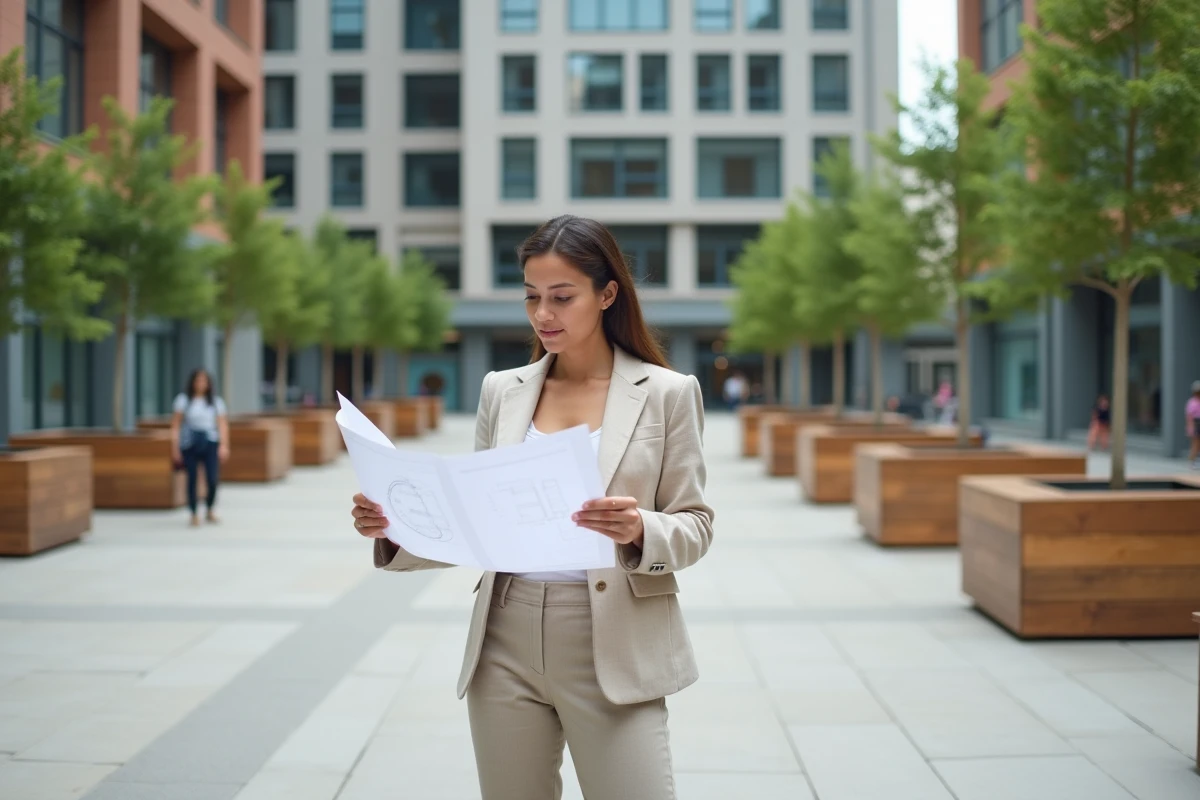
Have you ever noticed that some sidewalks make you want to walk, while others urge you to hurry? This difference is rarely random. It results from urban design choices that shape, meter by meter, the way we experience our cities. Behind a well-placed bench, a widened pedestrian crossing, or a tree planted in the right spot, there is a discipline that combines architecture, landscaping, engineering, and observation of human behavior.
When urban design serves climate adaptation rather than decoration
For a long time, designing a public space meant choosing a floor covering, placing furniture, and planting a few trees. That era is fading. The European program Horizon Europe, through its mission “Climate-Neutral and Smart Cities,” now directs urban projects towards a measurable goal: reducing heat islands and absorbing heavy rainfall.
In practical terms, this changes the hierarchy of decisions. An architect-planner no longer starts with the aesthetics of a square but with the flow of water and air. Impermeable surfaces are giving way to permeable soils, vegetated swales, and micro-basins integrated into the landscape.
This shift has a direct consequence on daily life. A square designed to manage a rainy episode remains passable after the storm, whereas a conventional asphalt parking lot turns into a giant puddle. The comfort of pedestrians and climate resilience converge towards the same technical solutions. The resources shared by Design en Ville illustrate how these approaches are spreading among communities and professionals.
Universal accessibility: urban design that benefits everyone
Have you ever found yourself pushing a stroller on a bumpy sidewalk or searching for a bench to catch your breath in a sunless street? These situations reveal a design flaw that penalizes far beyond just people with disabilities.
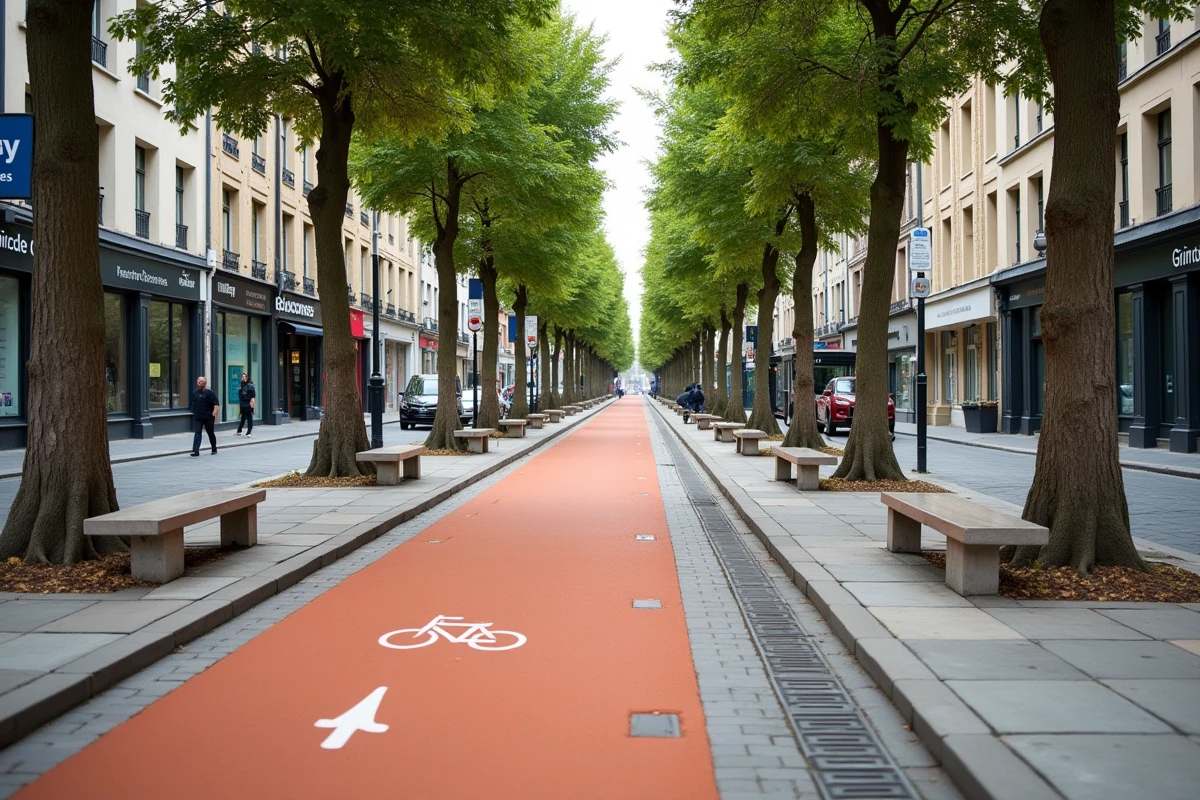
Recent publications from UN-Habitat on inclusive urbanism establish a simple principle: an area designed for the most vulnerable users works better for everyone. Elderly people, children, parents with strollers, delivery people on foot – everyone benefits from a continuous sidewalk, a clear visual contrast between roadway and pedestrian crossing, regular seating, and sufficient shading.
This approach changes the design method. Instead of adding accessibility at the end of the project (a ramp here, a tactile surface there), teams integrate specific criteria from the start:
- Pedestrian routes without level changes on at least two paths per neighborhood, with gentle slopes and lowered curbs at each crossing
- Visually contrasting urban furniture (color, material) for visually impaired individuals, positioned out of the main pathway
- Shaded seating areas every two hundred meters or so, combining benches with backrests and ischial supports for those who cannot sit fully
- Widened pedestrian crossings with crossing times adapted to a reduced walking speed
The result does not resemble a “specialized” layout. It simply looks like a pleasant street.
Greening and sustainable public spaces: beyond greenwashing
Planting trees in the city is widely agreed upon. The difficulty begins when deciding which trees, where, and with what soil. A poorly planted tree in a too-small pit dies within a few years and costs twice: at planting, then at removal.
The most advanced urban design projects treat vegetation as infrastructure, not as decoration. This involves ensuring sufficient soil volume beneath the sidewalk, choosing species suited to the future local climate (not just the current one), and connecting planting pits to the stormwater management network.
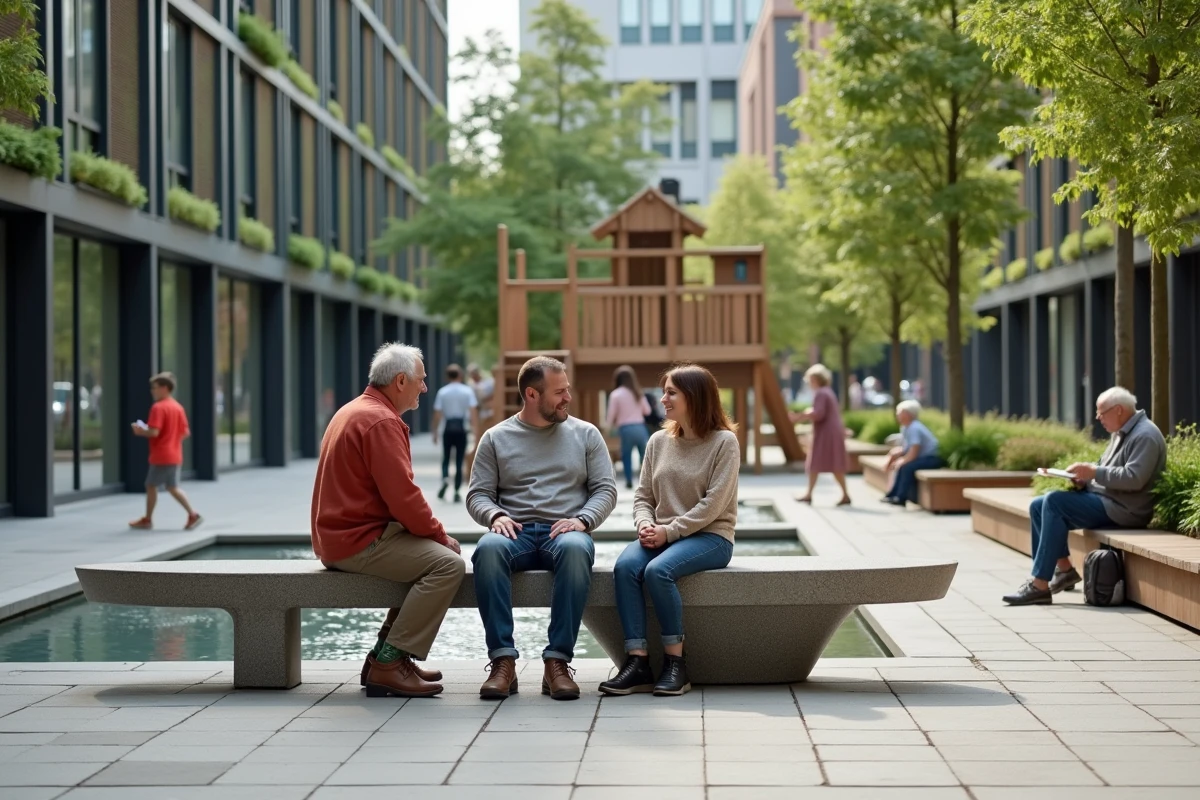
This systemic logic produces sustainable public spaces in two ways. Sustainable because the vegetation survives and grows. Sustainable because maintenance decreases when the design is good. A planted swale that filters rainwater replaces both a buried pipe and a flowerbed that is artificially watered.
What greening changes for residents
The difference is felt physically. A street lined with mature trees can be several degrees cooler than a neighboring mineral street in the height of summer. The shade makes café terraces usable, walking routes bearable, and facades less overheated.
Vegetal urban design simultaneously affects thermal comfort, air quality, and mental health. Studies in environmental psychology show that simply seeing a green space from a window reduces perceived stress. When that green space is accessible on foot, the effect is amplified.
Citizen co-design: involving residents in urban projects
Designing a public space without consulting those who use it is like designing a kitchen without asking who does the dishes. Contemporary urban design increasingly incorporates co-design approaches where residents contribute their in-depth knowledge of the area.
This resident expertise takes concrete forms:
- Urban walks organized with local residents to identify friction points (dangerous crossings, dark areas, underutilized spaces)
- Model-making or participatory mapping workshops where users propose layouts before the technical drawing phase
- Temporary installations tested for a few months before any permanent transformation, allowing adjustments to the project in real conditions
A project co-designed with residents is more likely to be adopted and maintained by the community. Ownership begins during the design phase, not after the inauguration.
Urban design is therefore not limited to making cities prettier. It redistributes comfort, safety, and climate resilience at the neighborhood scale. The technical choices made on a sidewalk or a square determine the daily quality of life for thousands of people for decades. This is what makes every square meter of public space as strategic as a large-scale urban planning scheme.