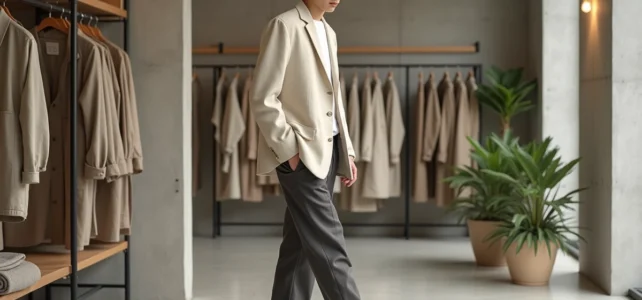
For several years, men’s and women’s sections have been losing their distinctiveness in an increasing number of French stores. Collections labeled “unisex” or “gender neutral” are appearing in both mainstream brands and independent designers. The phenomenon goes beyond mere runway curiosity: it affects how we put together outfits on a daily basis, the pieces we keep from one season to the next, and how we perceive our own silhouette.
Modular Wardrobe: The Link Between Gender-Neutral Clothing and Intentional Style
Recent image consulting content emphasizes an approach to style based on repetition and experimentation rather than following seasonal trends. The idea is to wear your clothes, test combinations, and understand what you truly like before making a purchase.
This logic of modular and reused wardrobe aligns particularly well with a gender-neutral wardrobe. An oversized shirt, straight pleated trousers, and a structured blazer work regardless of the gender of the person wearing them. These pieces gain longevity because they do not depend on a strict morphological code.
Building an intentional style means accepting to wear the same type of silhouette several days in a row to verify that it corresponds to what you want to express. A wardrobe made up of gender-neutral basics (thick t-shirt, mid-length trench coat, straight jeans) facilitates this process.
You assemble, adjust, and remove a layer without starting from scratch each season. To explore pieces designed with this in mind, the Hermaphrodite website gathers selections that do not originate from a men’s or women’s section.

Upcycling and Vintage in Service of Gender-Neutral Looks
The intersection between gender-neutral fashion and second-hand is increasingly visible in practice. Thrift stores, by nature, do not always segment their racks by gender. You can find a bomber jacket next to a tweed blazer, without any indication of destination.
Upcycling allows for the transformation of a gendered piece into a neutral one. Shortening a men’s coat, resizing a dress into a tunic, replacing buttons to change the perception of a garment: these creative gestures blur the boundaries without requiring a significant budget.
This approach has a concrete environmental advantage. Reusing and transforming existing clothing reduces the consumption of raw materials. However, the connection between gender neutrality and responsible fashion (sustainable materials, short supply chains, reuse) is still rarely highlighted in general style guides, which often treat the two subjects separately.
Gender-Neutral Image Consulting: An Emerging Practice in France
Traditional makeovers rely on binary reading grids: A, H, or V body shapes, categorized as feminine or masculine. In recent years, different types of image consulting have emerged. They no longer start from the category “female morphology” or “male morphology” but from personal style as the unique starting point.
Some of these consultations include workshops and even fashion shows where participants create outfits without reference to gender. The goal is not to eliminate all femininity or masculinity but to allow each person to choose the codes they wish to adopt.
Feedback on this point varies. For some image consulting professionals, abandoning traditional morphological markers complicates the recommendation of suitable cuts. For others, starting from personal style frees choices that the binary grid locked in. The practice remains emerging, and methodologies vary from one practitioner to another.
Key Pieces for a Gender-Neutral Wardrobe in Daily Life
Putting together a gender-neutral wardrobe does not require replacing everything. A few strategic pieces are enough to create a versatile base.
- The straight blazer, without pronounced shoulder pads, in a matte fabric (thick cotton, blended linen). It structures a silhouette without imposing a gendered reading and can be worn over a t-shirt or a shirt.
- The mid-rise trousers, straight or slightly loose fit. The pleats add volume without feminizing or masculinizing the line. Opt for neutral colors (black, beige, gray) to maximize combinations.
- The heavy cotton t-shirt, round neck or boat neck. A sufficiently dense weight avoids transparency and provides a good drape, regardless of body type.
- The flannel or denim overshirt, worn open like a light jacket. It serves as an intermediate layer and works on all body types.
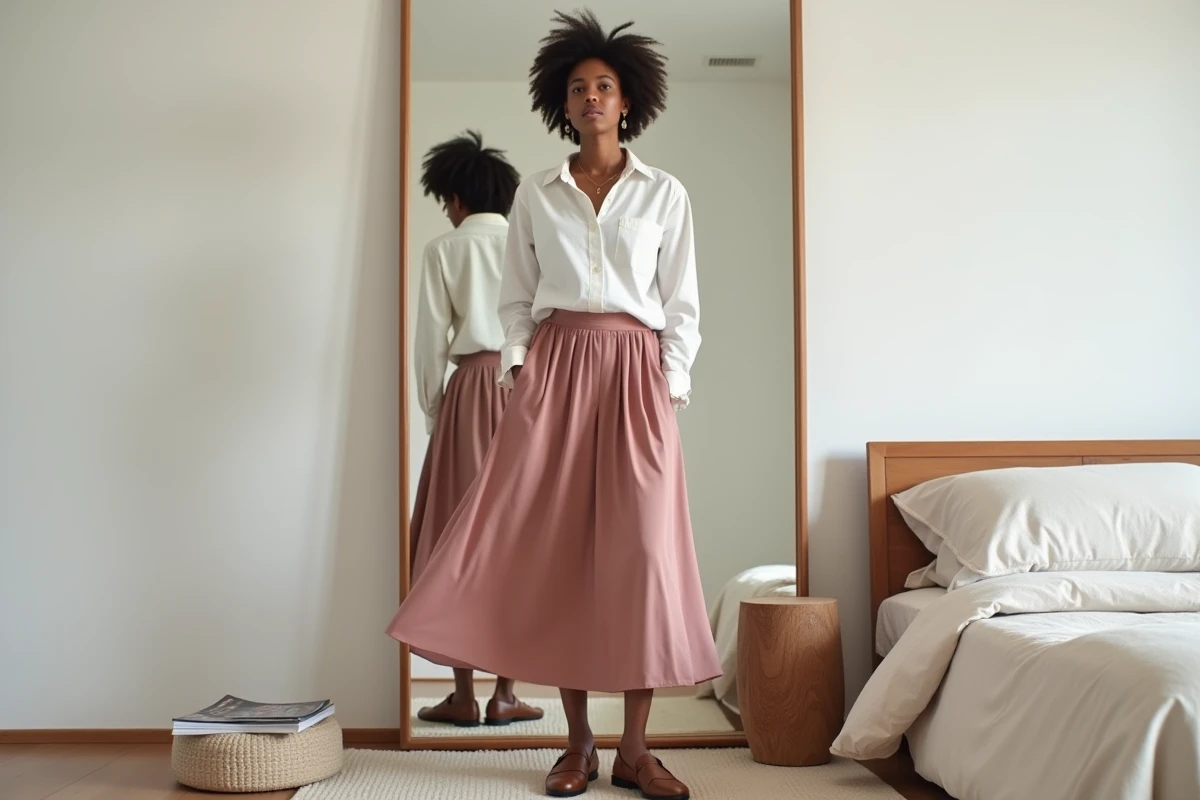
The main issue remains the cut rather than the label of the section. A garment labeled “men’s” can suit a woman if the proportions (sleeve length, shoulder drop, hip width) are checked in the fitting room. The in-store experience matters more than online browsing, where gendered filters remain the norm.
Limits and Open Questions on Gender Neutral Fashion
The term “gender-neutral” covers very different realities depending on the brands. Some collections merely offer sizes S to XXL on the same reference without rethinking the cut. Others genuinely rework patterns so that the same garment works on various bodies. The lack of standardization makes the “unisex” promise difficult to assess for consumers.
The question of price also arises. Brands specializing in gender-neutral fashion often position their collections in a mid-high segment, limiting accessibility. Second-hand and upcycling remain more affordable alternatives, but they require time and a minimum of know-how.
Culturally, reception varies. In France, major cities like Paris concentrate the offer and spaces where gender-neutral style can be worn without attracting comments. In other contexts, dress codes remain more pronounced. Available data does not allow for precise measurement of the proportion of the population adopting this type of wardrobe daily.
Gender-neutral fashion is progressing in both offerings and image consulting practices, but its integration into daily habits remains uneven. What is changing concretely is the possibility to choose: a blazer from the men’s section, a straight cut without justification, a style built on what you love to wear rather than what you are supposed to wear.