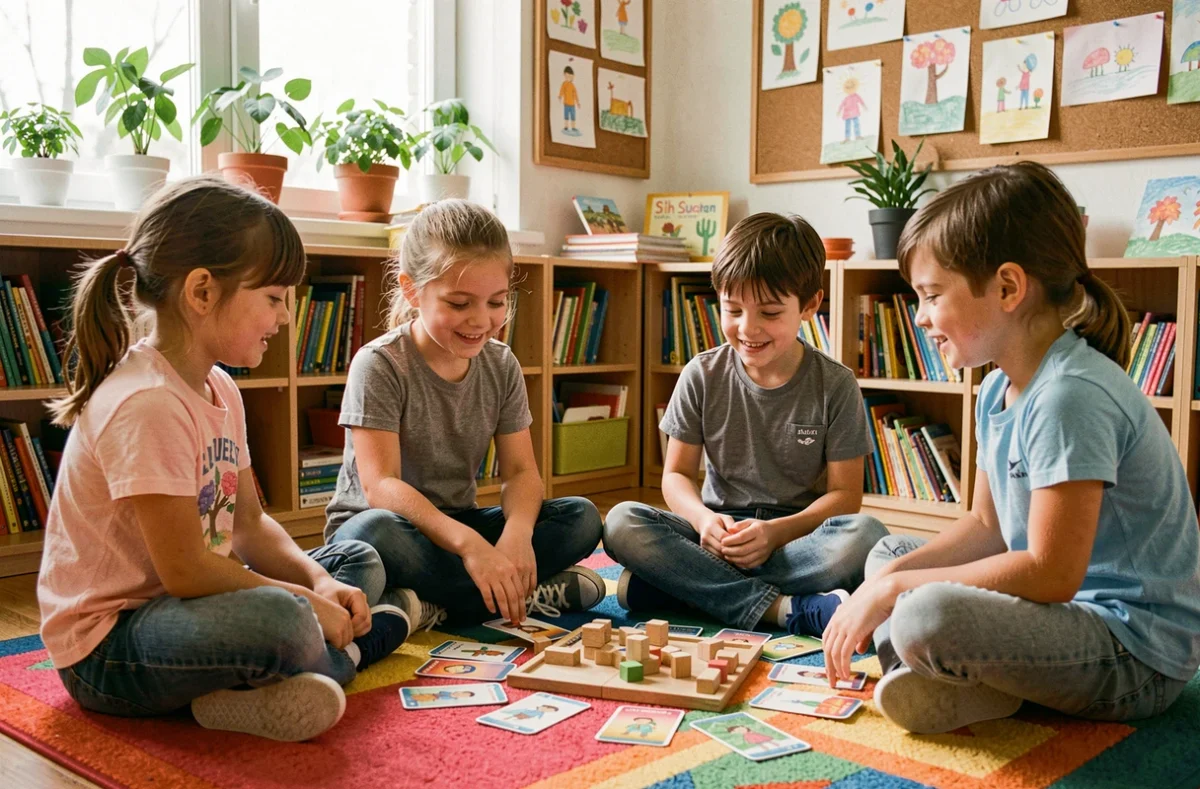
Not all games are equal in terms of educational value. The effectiveness of a playful activity in the classroom depends less on its fun aspect than on its design: is the game mechanics aligned with the targeted skill? Does the student have a real margin of decision? These questions guide the choice between a simple dressed-up exercise and a true lever for learning in school.
Guided play and free play in the classroom: two tools with distinct objectives
The confusion between guided play and free play remains common in school practices. The two formats do not engage the same skills in children, and treating them as interchangeable means losing the benefits of each.
| Criterion | Guided Play | Free Play |
|---|---|---|
| Teacher’s Role | Structures the situation around a specific skill | Observes and intervenes little |
| Student’s Decision-Making Margin | Framed choices within a defined framework | Complete initiative |
| Main Objective | Acquisition of a targeted concept | Exploration, creativity, initiative |
| Pedagogical Risk | Becoming a disguised exercise if too directive | Absence of connection with school objectives if not articulated |
| Assessment | Verifiable through oral or written feedback | More difficult to measure without structured feedback |
Guided play allows for framing a session around a specific goal (solving a mathematical problem, mobilizing vocabulary) while leaving students with tactical choices. Free play, on the other hand, opens a space for exploration where the child develops transversal skills such as cooperation or emotional regulation.
Recent research presents these two formats as complementary. Teachers looking to optimize play at school with SDN Rennes will find a useful framework to articulate these two approaches according to the context of their class.
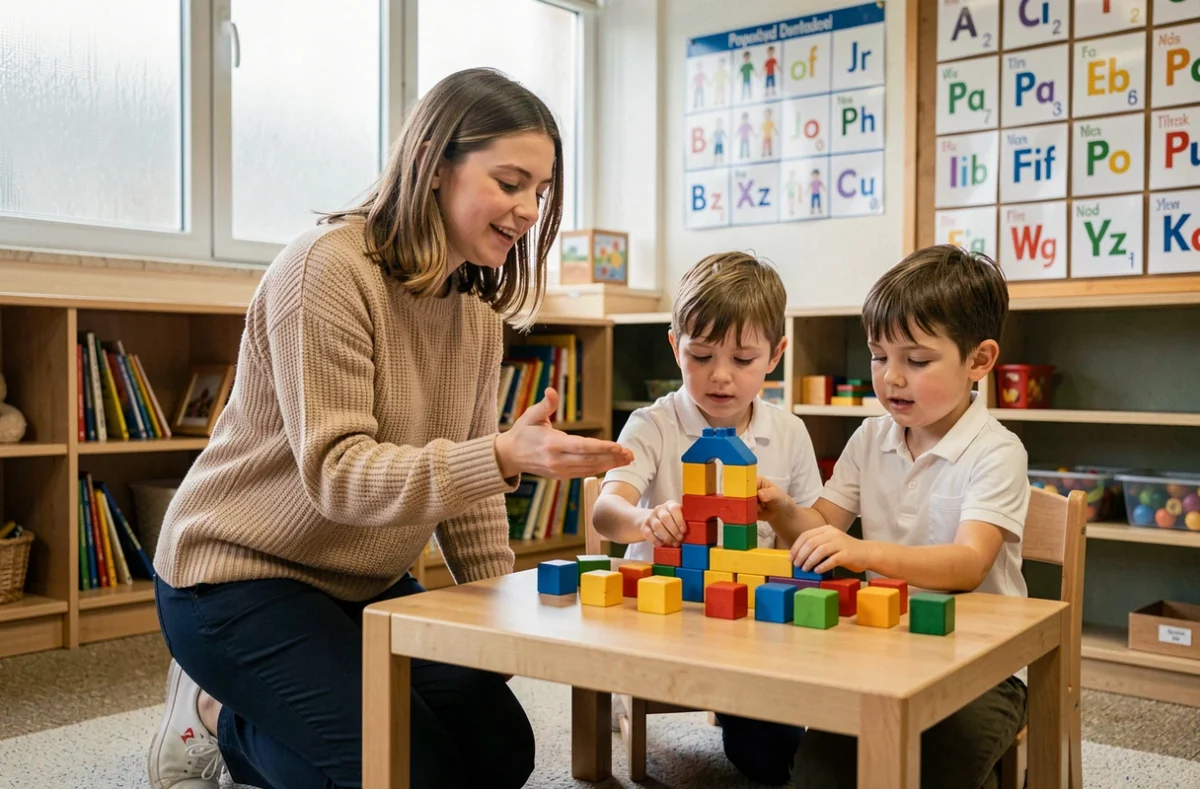
Pedagogical Design of Educational Games: Aligning Mechanics and Skills
Adding points, badges, or a timer to an exercise does not turn it into an educational game. The game mechanics must correspond to the targeted skill, not simply decorate an existing instruction.
A role-playing game in a language class, for example, places the student in a situation of authentic communication. The mechanics (embodying a character, reacting to an unforeseen situation) directly correspond to the objective (producing spontaneous oral discourse). In contrast, a points quiz on the same content only engages the recall of knowledge.
Three Criteria for Evaluating the Pedagogical Alignment of a Game
- Does the main game mechanic require mobilizing the targeted skill to progress, or can one win without using it?
- Does the student make decisions that influence the course of the game, or do they simply answer closed questions?
- Does the game generate exploitable errors in class, meaning situations where the child can analyze why their strategy did not work?
A well-designed game makes errors productive rather than punitive. A student who loses a round because they misestimated a quantity in mathematics receives immediate feedback on their approach, facilitating adjustment without corrective intervention from the teacher.
Assessment of Learning through Play: Going Beyond Scores and Engagement
An enthusiastic student is not necessarily a student who learns. Active participation and enjoyment are indicators of engagement, not mastery. Recent syntheses on educational games remind us that results vary greatly depending on contexts and objectives, making the measurement of real learning all the more necessary.
The most documented strategy involves planning a structured feedback time after the game. This debriefing does not take long, but it changes the nature of the activity.
Feedback After the Game: What It Produces in Practice
Asking students to explain their reasoning (“How did you decide to group these cards?”, “What strategy did you change during the game?”) forces them to verbalize their thinking. This phase of metacognition transforms a playful experience into conscious learning.
Without this feedback, the game risks remaining a pleasant interlude whose gains evaporate. With it, the teacher has qualitative indicators (students’ formulations, identified errors, spontaneous transfers) that complement quantitative data such as scores.
Schoolyard Design: An Underutilized Lever for Active Play
The physical space conditions the types of games possible. A uniformly paved playground favors ball games and effectively excludes a large part of the children who do not find themselves in it. The design of the playground directly influences the diversity of learning through outdoor play.
Recent guides dedicated to schoolyards recommend dividing the space into zones with distinct functions: an active play area (running, climbing), a quiet area (reading, outdoor board games), a symbolic play area (cabin, role-playing spaces). This spatial organization allows each child to find a type of play that suits them.
Active play, in particular, meets the need for movement that indoor activities often limit through strict rules. The outdoor environment frees these motor impulses and offers complementary learning to that of the classroom.
Serious Games in Schools: When Digital Provides Real Added Value
The use of serious games in class is justified when the digital format offers something that physical games cannot: simulation of inaccessible environments, instant and personalized feedback, real-time adjustment of difficulty levels.
- Scientific simulations (ecosystems, electrical circuits) allow manipulation of variables without material constraints or risks
- Management games (budget, resources) confront the student with the cumulative consequences of their decisions over several rounds
- Adaptive platforms adjust difficulty based on responses, preventing boredom in advanced students and discouragement in others
A poorly calibrated serious game pedagogically remains just another screen. The selection criterion remains the same as for a physical game: the mechanics must require the mobilization of the targeted skill. A digital quiz with animations is no better than a paper quiz if the cognitive task is identical.
The choice between physical and digital games thus depends on the learning objective, not on a principled preference for one format over the other. Teachers benefit from testing both on the same skill and comparing students’ outputs during feedback phases.
The takeaway from all these strategies is a simple observation: learning through play is measured by the quality of design and debriefing, not by the enthusiasm it generates. A game well aligned with a skill, followed by structured feedback, produces observable results. Without these two conditions, the playful aspect remains just a façade.