
A retiree looking to understand their rights to the APA comes across an outdated Cerfa form. Another wants to compare senior residences in their department, but the directories list establishments that have been closed for two years. Finding the right information online when you are a senior, or when you are assisting an elderly loved one, requires knowing where to search and quickly sorting what is reliable.
Digital Divide Among Seniors: Two Realities Based on Age
Seniors are often talked about as a uniform block when it comes to digital technology. The reality on the ground is more nuanced. Illiteracy in digital technology affected 13% of those aged 60-74 compared to 54% of those aged 75 and older, according to data from Insee reported by La Gazette des communes in September 2026.
This distinction changes everything in how online resources are organized. A 62-year-old retiree who uses their email and bank accounts daily does not have the same needs as an 80-year-old who has never used a mouse.
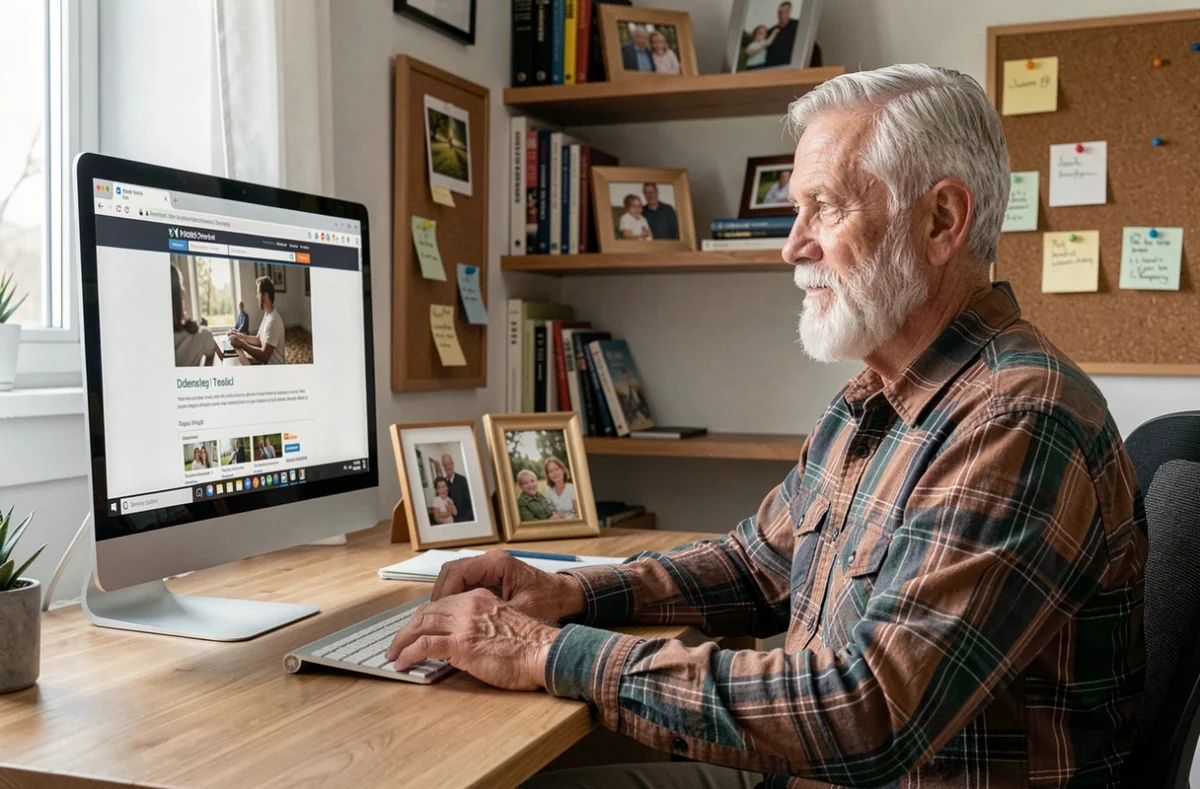
For the former, the issue is not access but sorting information. Institutional portals (for-les-personnes-agees.gouv.fr, pourbienvieillir.fr) gather practical sheets on autonomy, social assistance, adapted housing, or health prevention activities. The problem is that these sites are rarely interconnected, and one must navigate between several sources to cover a single topic. Exploring the pages of guideseniors.fr allows you to visualize the range of themes covered by a specialized directory, from housing to home services.
For those over 75, physical support remains the main lever. Free digital workshops, like those documented by France Info, offer seniors the chance to learn how to detect online traps in a supervised setting. These local training sessions often serve as the first entry point to online resources.
Online Scams and Seniors: The Real Numbers Contradict the Stereotypes
Seniors are often portrayed as the primary victims of digital scams. Recent data strongly nuances this portrayal.
A barometer published on September 15, 2026, indicates that those aged 55-75 are more vigilant after a data breach than those aged 18-34: 68% compared to 57%. Young professionals represent a larger share of victims of banking scams than retirees, as reported by several studies covered by the specialized press.
This observation does not mean that seniors are safe. Fraud through manipulation (fake bank advisor, urgent request for payment validation) significantly increased in 2025. According to the Observatory of Payment Means Security of the Banque de France, these scams now account for more than 40% of payment fraud.
Scenarios to Know for Protection
- The fake bank advisor who calls pretending to be your bank and asks you to validate a “security” operation: no bank ever asks you to validate a payment over the phone
- The SMS or email about a package delivery with a link to a site mimicking La Poste or Chronopost: check the URL before clicking, and never enter your banking details on a site you are not sure about
- Fake fines or false tax notices sent by email: the tax administration never requests immediate payment via a link in an email
An online guide useful for seniors should present these mechanisms without infantilizing them. The resources from Cybermalveillance.gouv.fr and the ANCT detail phishing techniques with concrete examples and screenshots.
Key Sections of a Senior Portal: What Really Helps in Daily Life
We reviewed the main categories covered by portals aimed at seniors. Three themes concentrate the majority of concrete searches.
Assistance and Rights Related to Autonomy
The APA, the PCH, and assistance for adapted housing are the most searched topics. The national portal for-les-personnes-agees.gouv.fr remains the reference for practical sheets on assessing loss of autonomy and associated rights. It also includes a directory of local information points and comparisons of EHPADs with quality indicators.
Home Services and Support
The Federation of Home Services (Fedesap) lists approved structures for home assistance. A good reflex: check that the provider has an approval or authorization from the departmental council, which conditions access to certain financial aids.
Feedback varies on the quality of online directories in this area. Some are updated regularly, while others display outdated contact information. Cross-referencing at least two sources before contacting a provider helps avoid disappointments.
Health and Prevention
The portal pourbienvieillir.fr, supported by pension funds, covers adapted physical activity, nutrition, and cognitive stimulation. The prevention workshops offered by the funds (memory, balance, nutrition workshops) are listed there with registration details according to the department.

How to Assess the Reliability of an Online Senior Resource
Not all sites aimed at seniors are created equal. A few criteria allow for quick sorting.
- The publisher is identifiable (complete legal notices, legal structure, physical address). A site without clear legal notices does not deserve to have personal data entered
- The information is dated. An article on social assistance without a date of update may reflect outdated rates from several years ago
- Institutional sources are preferred: .gouv.fr sites, pension funds, local authorities. These organizations have a regulatory obligation to update
- The site does not condition access to information on a purchase or subscription. Public and associative portals offer free access to practical sheets
Specialized private portals (comparative guides, thematic directories) usefully complement institutional sites, provided that their business model is verified. A comparator funded by the establishments it references does not offer the same level of objectivity as an independent directory.
The most effective reflex remains to start from your specific need (home assistance, housing adaptation, retirement rights) and to systematically cross-reference a public portal with a specialized guide. Two concordant sources are better than a single article, no matter how comprehensive it may be.