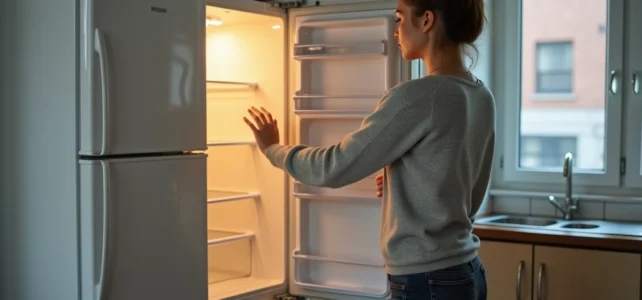
A refrigerator breaks down in a rented empty apartment. The tenant has been using it since moving in, but the lease does not mention any furnished rental. Who is responsible for paying for the repair or replacement? The answer depends less on the type of appliance than on its legal status in the rental agreement.
Legal status of the refrigerator in an empty rental: the tipping point
The central distinction lies in how the fridge is listed (or not) in the lease and in the move-in inventory. Three situations coexist in practice, and the financial consequences differ radically.
Read also : Tips and Inspirations to Succeed in Your Gardening and Enhance Your Outdoors
| Situation | Does the owner have to repair or replace? | Can the tenant demand intervention? |
|---|---|---|
| Fridge listed in the inventory or move-in report as part of the housing | Yes, unless proven fault of the tenant | Yes, by registered mail followed by a formal request |
| Fridge left “for free use” with a clause in the lease | Depends on the wording of the clause (often contestable) | Partially, if the clause is deemed abusive |
| Fridge belonging to the tenant (purchased or brought) | No | No |
This table summarizes the logic adopted by local courts. The most contentious case remains that of the fridge “made available” without a precise inventory.
When a broken fridge in an empty rental appears in the move-in report as a functional appliance, the landlord bears the cost of its replacement in case of wear or normal failure. The move-in report determines who pays.
Read also : Interpretation and Meaning of Animals in Dreams: The Squirrel in Particular

Clause for free use: a common contractual trap
Many landlords leave a refrigerator in an equipped kitchen without transitioning to a furnished lease. They add a clause to the contract stating that the appliance is “made available for free” and that its maintenance or replacement is the tenant’s responsibility.
This practice is increasingly contested in court. Courts consider that these clauses cannot transfer to the tenant the repairs related to wear. The landlord’s obligation to provide decent housing, as required by law, takes precedence over any contractual clause that would deviate from it.
What judges concretely examine
- Is the appliance mentioned in the move-in report with a description of its condition? If so, the landlord is presumed responsible for its compliance.
- Does the clause place “generally and without nuance” all repairs on the tenant? This type of wording is considered abusive when the breakdown is due to normal wear.
- Has the tenant reported the breakdown in writing within a reasonable time? A late report can complicate their position.
In practice, a refrigerator older than ten years that stops working almost always falls under wear. Wear remains the landlord’s responsibility, even with a contrary clause.
Climate and Resilience Law: an indirect lever for refrigerator replacement
The link between a broken refrigerator and the energy performance of the housing is not obvious at first glance. However, the Climate and Resilience Law creates additional pressure on landlords.
Housing classified as G is gradually being banned from rental, followed by housing classified as F. An old, energy-hungry refrigerator can weigh on the energy performance diagnosis (DPE) of the housing. Replacing an energy-hungry fridge can improve the DPE rating of the housing, which encourages some landlords to anticipate replacement rather than wait for a breakdown.
For the tenant, this argument provides an additional negotiation lever. Mentioning the energy impact in a letter to the landlord strengthens the request, especially if the housing is in a fragile energy class.
Concrete steps for the tenant facing a faulty refrigerator
The procedure to follow follows a logic of escalation. Each step conditions the next.
Written notification to the landlord
The tenant sends a registered letter with acknowledgment of receipt describing the breakdown, the date of observation, and the reference of the appliance as it appears in the move-in report. A simple SMS or phone call does not constitute usable evidence in case of dispute.
Response time and formal notice
No text sets a precise legal deadline for repairs. However, if the landlord does not respond within a reasonable time (generally estimated at a few weeks), the tenant can send a formal notice. This document reminds the obligation to provide decent housing and sets a new deadline.
Referral to the departmental conciliation commission
Before any legal action, conciliation is a free and often effective step. The departmental conciliation commission (CDC) can be contacted by mail. It summons both parties and attempts to find an amicable agreement.
- The referral is free and does not require a lawyer.
- The processing time varies by department but is generally less than a few months.
- If conciliation fails, the tenant can refer the matter to the protection litigation judge.
Judicial recourse
The protection litigation judge is competent for rental disputes. They can order the replacement of the appliance and, in some cases, award damages if the landlord has failed in their obligation to provide.
A broken fridge in an empty rental does not automatically generate a dispute. Most situations are resolved at the registered letter stage, provided the tenant relies on the move-in report and the nature of the breakdown rather than a simple oral request. The contractual status of the appliance remains the factor that settles the debate.